
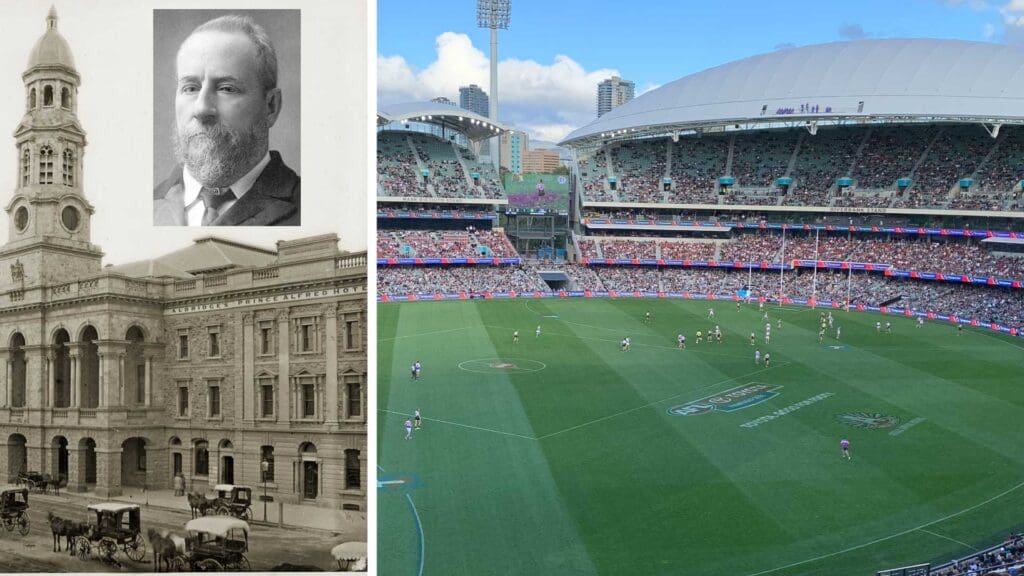
South Australia has a special interest in seeing Australian rules football reach its full potential as a great – if not the greatest –game. That’s because we made the game happen in 1876. At a meeting in the Prince Alfred Hotel (next to, and later part of, Adelaide Town Hall) the mess of conflicting rules among early South Australian clubs was sorted out. The sorter in chief, as was his sway, was Charles Cameron Kingston, a future premier, a bit of a pants man who didn’t mind taking up the challenge of a pistol duel in Victoria Square, and a player and president of the South Adelaide club.
Kingston would be installed in the Australian history hall of fame for crucially insisting at the 1876 meeting that a player shouldn’t be able to run with the ball without bouncing it and also insisting on an oval-shaped ball being used. This enabled South Australia to play inter-colonial football against Victoria that had settled on those rules. This was the start of Australian football having national reach. Without it happening, we, and maybe even Victoria, could have switched to being rugby states.
South Australian sports historian Dr Bernard Whimpress pointed out that New South Wales people had been playing the nascent Australian game early on against the Victorians “but they regarded the Victorians as tyrants, so they basically chucked it and imported rugby”.
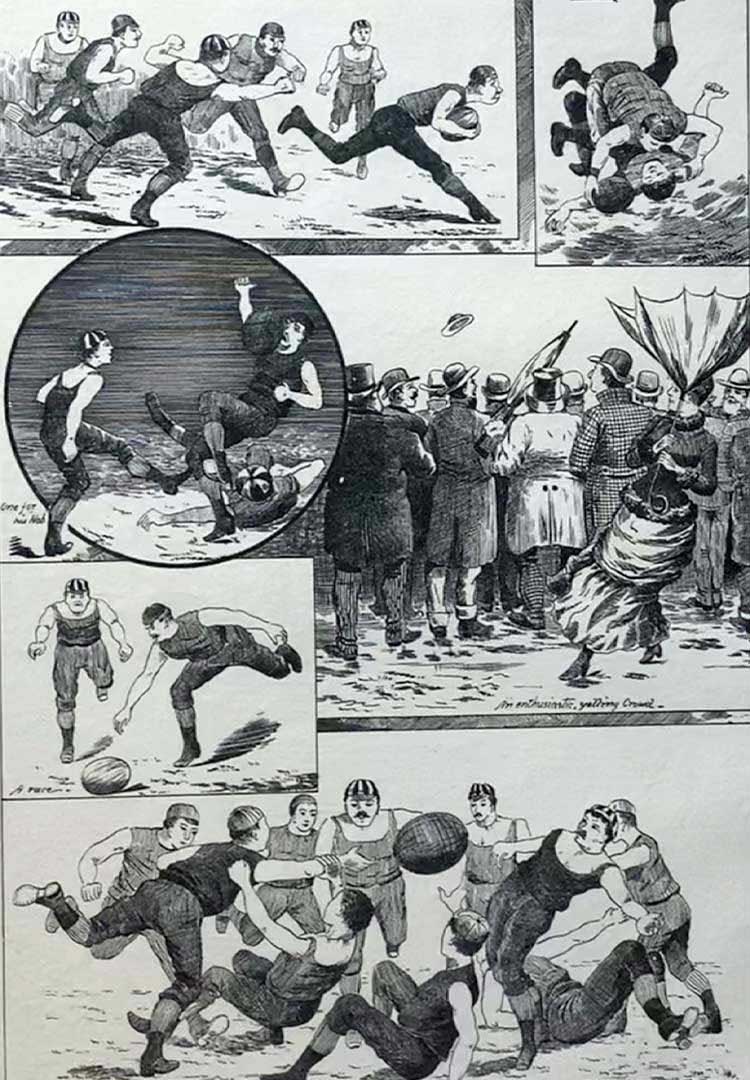
Mad scramble organised into Australian rules
South Australia’s special interest in seeing Australian rules football reach its full potential comes from setting up the game the go national in 1876 by adopting the rules that refined it from previous mad scramble of play that mixed elements of rugby and soccer in its variations.
The South Australian Football Association formed in 1877 was one of the first sporting organisations in the world
The association became the South Australian National Football League’s formidable suburban competition that still has a grip on local nostalgia at the expense of a wider vision for the game.
Yes, we can fondly look back on days such as North Adelaide’s Barrie Robran mightily smiting Carlton in the 1972 Champion of Australia game. Or, a personal favourite: Paul Bagshaw of Sturt being debagged of his shorts at an Adelaide Anzac Day match in front a packed John Cresswell stand. He coolly and classily carried on and bagged his set shot for goal. And we always knew there would be brilliant playing on that same half-forward flank every 1960s grand final at Adelaide Oval – by the South Australia Police Band, who could only be heard by the toffs in the members’ stands. (Typical!)
But we have to concede that the more professional Australian Football League is producing fitter, faster and more skilled players. We have to appreciate how today’s best players are making that ball sing with great accuracy under brutal pressure. That pressure can make players who are not up to A Grade standard look ordinary. Australian rules football at the top level needs to be showcased by more players at the top level. That’s why we need to ensure the quality of top players is not diluted by moves such as extending the competition with the Tassie Devils. Alternately, despite the doubters, expanding teams in New South Wales and Queensland has paid off. Those states will see a lot more balls bounced there – thanks to rules decided at Adelaide’s Prince Alfred Hotel in what will be 150 years ago next year.