Brant Eustice brilliantly captures the warmth and complexity of Alan Turing, the gay pioneer of AI (artificial intelligence), in St Jude’s Players Breaking The Code.
Eustice’s performance solidifies his place among Adelaide’s elite actors and the excellent supporting cast shows the depth of local talent.
Alan Turing OBE FRS was a brilliant mathematician recruited by the British government in 1939 to work at the Government Code and Cipher School at Bletchley Park. He led a team of cryptanalysts, mathematicians and engineers charged with cracking the code of the German cipher Enigma machines used for top secret naval, military and diplomatic communications. His work on the Bombe machine that broke the German code was said to have shortened the war and saved thousands of lives. This work was a catalyst for Turing’s later work on a digital computer or “electronic brain” and his quest to design a machine that could think, the precursor of artificial intelligence.
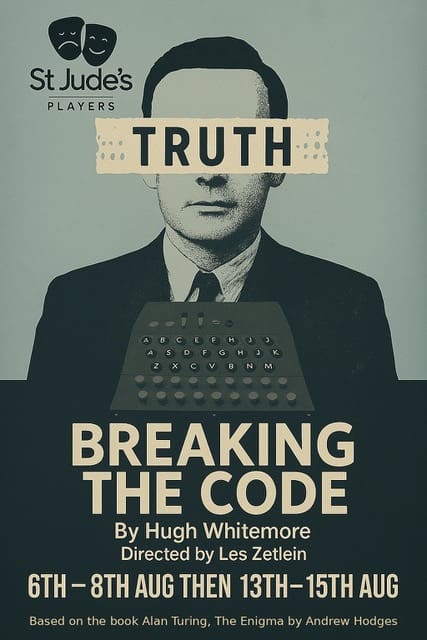
Breaking The Code by High Whitemore
Presented by St Jude’s Players
Directed by Les Zetlein
Based on the book, Alan Turing, The Enigma by Andrew Hodges
6-15 August, 2026, St Jude’s Theatre, 44 Brighton Rd, Brighton, SA
Turing was gay, leading to him being charged with gross indecency when he naively confessed to a relationship with a young man. As a convicted criminal, he was offered chemical castration instead of jail, possibly contributing to his suicide in 1954 at 41. The tragedy lies not only in his future discoveries we were denied but also in his personal life.
Turing is a complicated character but Eustice channels him expertly. He captures Turing’s humour, his frustrations about hypocrisy and bureaucracy, his social awkwardness, his capacity for love, hatred of pretence and his annoyance at irrational thought concerning religion and the injustice of homophobic laws. It’s a deeply emotional portrayal of this intellectual giant, showing how much people, not machines, were an enigma to Turing.
Hugh Whitmore’s play is dense and manages to capture not only the personal but the important, ground- breaking theory of computer science and Turing’s philosophical thoughts on the subject.
Director Les Zetlein has chosen a strong and experienced cast. Jamie Black as the detective who charges Turing plays it perfectly. He initially handles the case without emotion but the way he draws Turing in is almost entrapment. He represents the morals of the day and carries out the law with detachment.
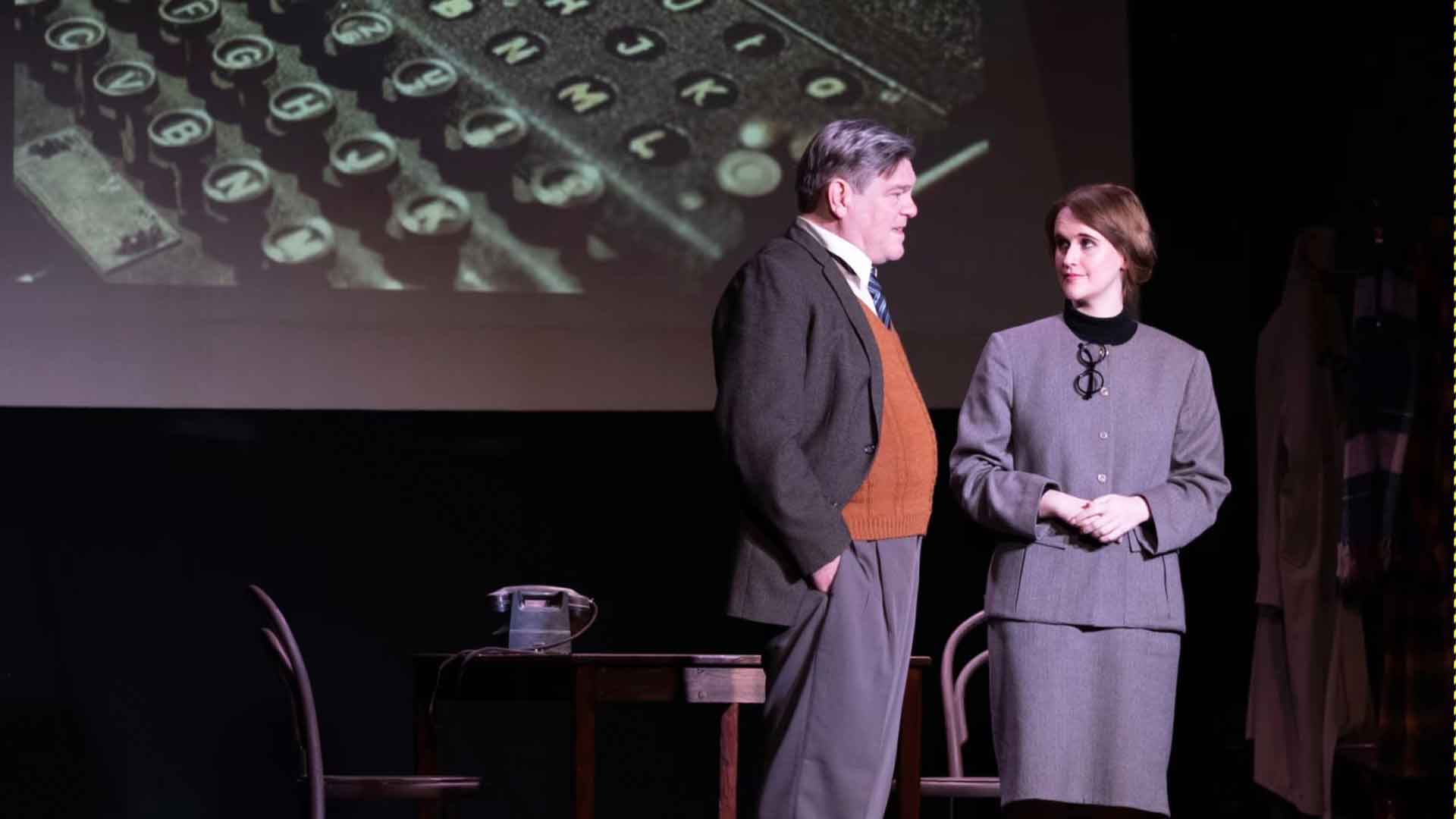
David Lockwood as the classics scholar and cryptographer Dillwyn Knox who recruited Turing is wonderfully nuanced. He delivers some of the play’s best lines as he advises Turing to not break the other code – to practise discretion in his private life and to not buck the establishment system. Knox offers reasons why many are challenged by Turing’s openly gay lifestyle. Turing, who understood machines better than people, is forced to consider Knox’s advice. Revelations about Knox’s own private life give this exchange even more gravitas and show how perfectly Lockwood portrayed this character. Applause at the end of his act 2 scene with Turing was well deserved.
Rhonda Grill as Turing’s mother is a delight. All 1950’s British church-going middle class, confused about her son’s brilliance and sexuality but loyal and loving. Tianna Cooper plays Turing’s loving friend and fellow cryptographer with great warmth and energy. Her intellect and understanding about his lifestyle are sensitively portrayed. Peter Davies plays a solid very convincing British government chap who has no choice but to cancel Turing’s security clearance.
Sebastian Hollingsworth is Turing’s “bit o’rough” with whom he has an affair. He is flirty and duplicitous and conveys the sense of foreboding that we all feel on their first meeting.
Nicholas Koulioubus came into his own as Turing’s Greek lover and provided a glimpse into a joyful non-closeted world as they holidayed on Corfu.
Turing was pardoned by Queen Elizabeth II in 2013. This led to Turing’s Law being passed in 2017 when an estimated 75,000 men were pardoned for crimes of “gross indecency”, 65 years and many destroyed lives later.
Les Zetlein has given us a very satisfying drama about an important but tragic historical figure. The social themes, the work and discussions about AI are just as relevant today.
– Vicki Arnold