
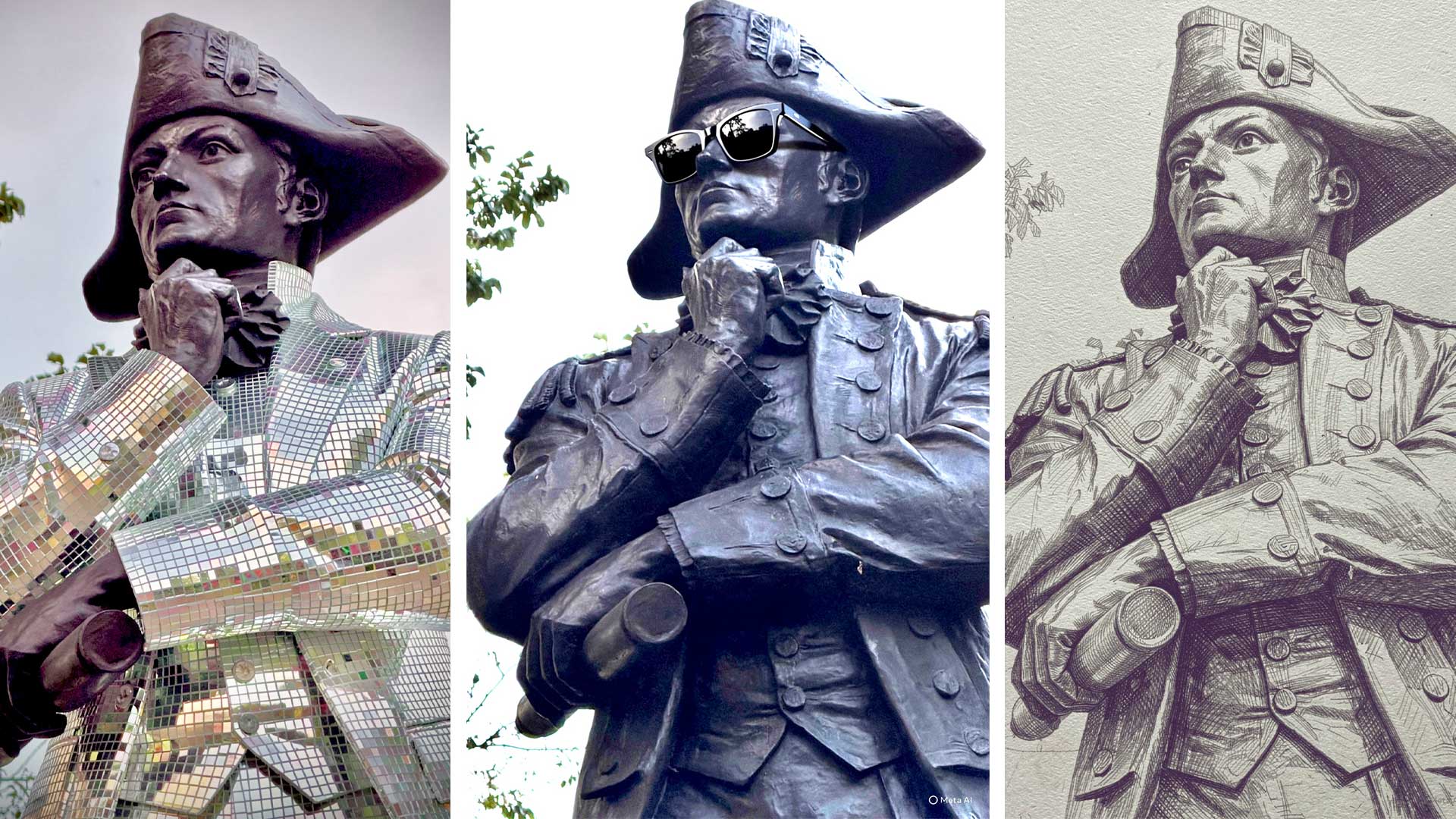
No disrespect here. If these AI-enhanced images – by Fabula Files’ freewheeling photographer Kylie Fleming – get attention for captain Matthew Flinders and his statue, it makes up for South Australia’s past lack of respect for the state’s discoverer in a heroic and global sense.
Adelaide’s Flinders statue, by Frederick Brook Hitch, was ultimately unveiled in 1934. But rather than a prominent place like Victoria Square, the statue was placed “largely obscured by trees” on North Terrace’s Prince Henry Gardens. This was no way to treat one of the world’s most accomplished navigators and hydrographers who had discovered South Australia in a real and detailed and global sense.
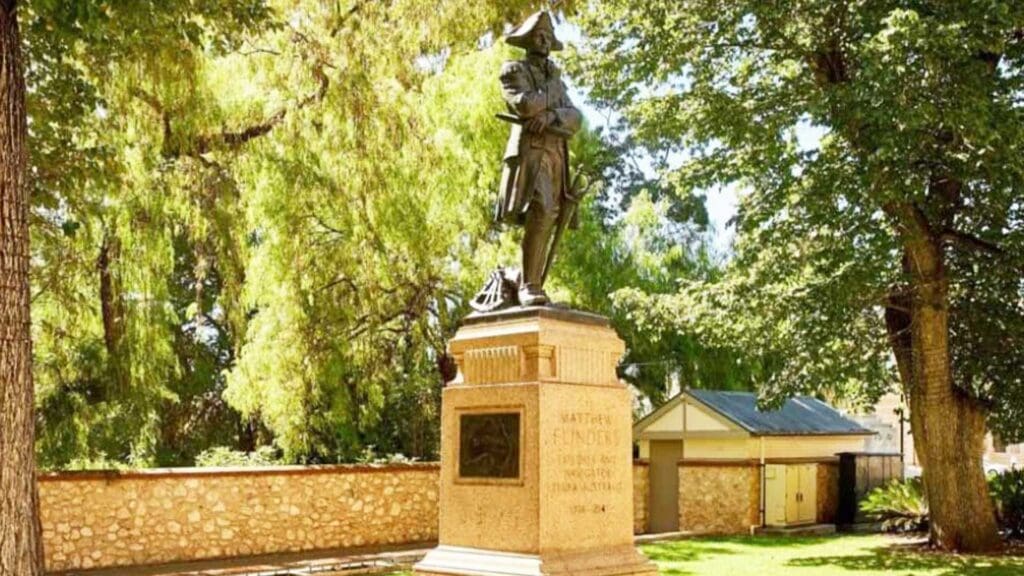
Flinders had in 1802 meticulously explored and mapped the “unknown coast” between the head of the Great Australian Bight and the River Murray – the future South Australia overlooked by the Dutch and French.
Naval explorers like Flinders and Cook have been perversely castigated by some as opening the way for the colonisers’ ravages especially against Indigenous people. Those Indigenous people had an inherited intense survival knowledge of their home territories and but had no knowledge of their place in the wider or even Australia as a continent, They probably would have been happy to have been left in that state. Many other humans also were content not to have that global knowledge.
Explorers like Flinders and Cook certainly were sent out to find areas to be conquered and exploited for resources, But the feats of explorers such as Flinders and Cook have to be admired in their own right; crossing ferocious oceans in tiny ships without any outside communication. They are also to be admired by those who value the positives – not the misuse – of knowledge in its own right. The global knowledge that Flinders helped build opened up universal knowledge that allowed a new generation of explorers, as astronauts, to circle the Moon.